The Reactivation Email: Win Back Past Clients
- Past clients are your warmest pipeline - they already trust you and know your work.
- Win them back with a short, specific email that leads with them, not with your need for work.
- Give a concrete reason for reaching out now, and make the reply effortless.
How to Win Back a Past Client With One Email
To win back a past client, send a short email that leads with them, not with your need for work: open on a genuine personal note, give a real reason you are reaching out now (an idea, an improvement to what you built, a timely nudge), name one specific way you could help, and end with a one-line ask. Keep it under a screen's worth of text and skip 'just checking in.' A past client is your warmest lead - they already trust you - so a warm, specific, low-pressure message reopens the door instead of sounding desperate.
The cheapest work you will ever win is from someone who already paid you and was happy. A past client has cleared every hurdle a cold lead has not: they trust you, they know your work is worth the money, and they have already survived the awkward first-project uncertainty. Yet most builders let these relationships go cold and spend all their energy chasing strangers instead.
Learning to win back past clients turns a graveyard of finished projects into a live pipeline. People change jobs, budgets reopen, and the problem you solved last year has quietly grown a sequel. A single well-timed reactivation email can reopen a door that took months to earn the first time, at a fraction of the effort of a cold campaign.
Why Reactivation Emails Feel Weird, and How to Fix It
The reason most builders never send these emails is that they imagine sounding desperate: 'Hey, remember me? Got any work?' That version is weird because it leads with your need. The fix is simple - lead with the client, not with yourself. A reactivation email that opens the door instead of asking for a handout is one that gives before it takes.
The whole trick is to reach out as someone who was thinking about their business, not someone scanning their contacts for a paycheck. When the email is genuinely about them - a relevant idea, a useful nudge, a real reason you thought of them today - the ask at the end feels natural instead of needy. Warmth removes the weirdness.
The Reactivation Email: A Four-Part Shape
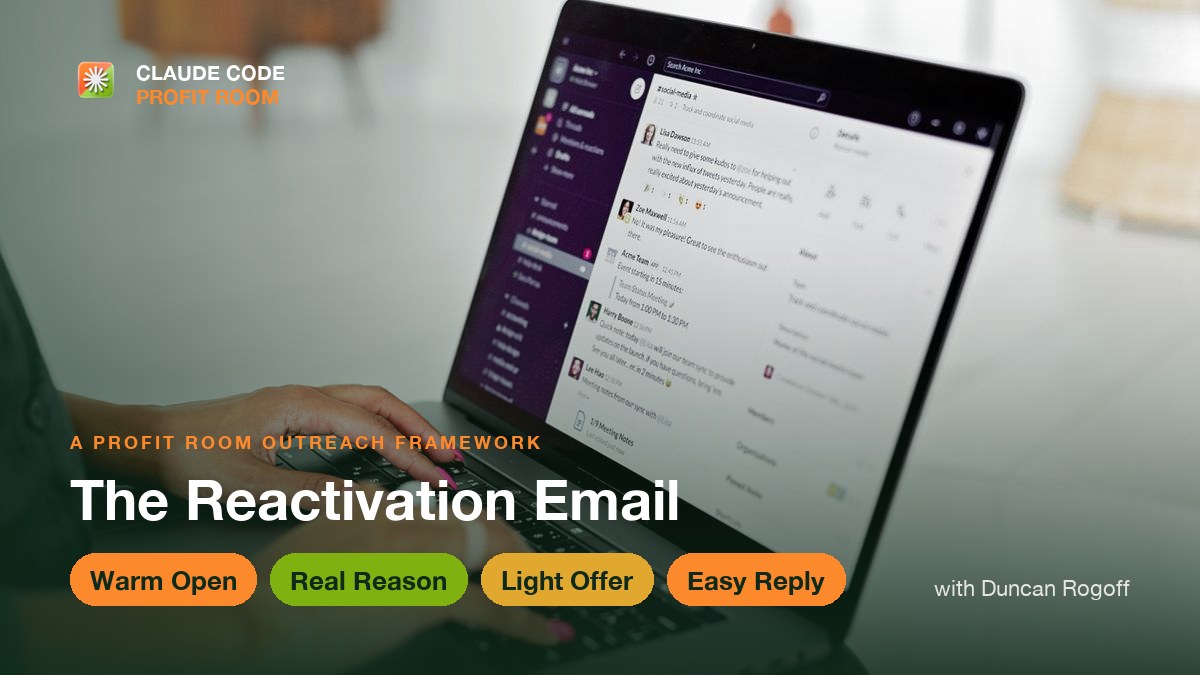
Every reactivation email that reopens a relationship follows the same short shape. Keep the whole thing under a screen's worth of text - a busy past client will not read an essay. Name the shape so you can reuse it: the Warm Open, the Real Reason, the Light Offer, and the Easy Reply.
| Part | What it does | What to avoid |
|---|---|---|
| The Warm Open | Reconnects on a genuine, personal note | Generic 'hope you're well' filler |
| The Real Reason | Gives a concrete reason you reached out now | 'Just checking in' with no substance |
| The Light Offer | Names a specific way you could help | A vague 'let me know if you need anything' |
| The Easy Reply | Makes saying yes a one-line answer | Asking them to schedule or do the work |
The four parts of a reactivation email
Give a Real Reason You Are Reaching Out Now
The line that saves a reactivation email from feeling like spam is a specific reason for the timing. 'Just checking in' is the phrase that gets deleted, because it signals you have nothing to say and are fishing. A real reason - you saw something relevant to their business, you built a tool that solves the exact problem they had, the season they get busy is coming - tells them this email is about them, not about your empty calendar.
Make the Reply Effortless, and Never Pressure
End the email with the smallest possible next step. A past client is far more likely to reply to 'Want me to send over a quick idea?' than to 'Do you have thirty minutes to jump on a call this week?' The first is a one-word yes; the second is a task. Lower the cost of replying and more people will.
How to Win Back Past Clients, Step by Step
Turn your finished projects into a reactivation routine you run a few times a year, not a thing you only remember when work is thin. Because these leads are already warm, a small, steady habit here quietly refills your pipeline with the easiest work you can win.
- List past clients who were happy with the work and could plausibly need more.
- For each, find a real reason to reach out now - an idea, an improvement, a timely nudge.
- Write a short email: Warm Open, Real Reason, Light Offer, Easy Reply.
- Lead with them, not your need for work, so the message feels warm rather than desperate.
- End with a one-line yes, and if there is no reply, leave it and try again in a few months.
Short, practical drops on offers, outreach, pricing, and closing clients with Claude Code. No spam, unsubscribe anytime.
Frequently asked
How do I win back a past client without sounding desperate?
Lead with them, not with your need for work. Open on a genuine personal note, give a real reason you are reaching out now - an idea, an improvement to what you built, a timely nudge - and end with a low-pressure, one-line ask. When the email is clearly about their business rather than your empty calendar, the awkwardness disappears and the reconnection feels natural.
What should a reactivation email say?
Keep it under a screen's worth of text with four parts: a Warm Open that reconnects personally, a Real Reason that explains why you are reaching out now, a Light Offer naming a specific way you could help, and an Easy Reply that makes saying yes a single line. Avoid 'just checking in' - a concrete reason is what separates a welcome email from spam.
When is the best time to reach out to a past client?
When you have a genuine reason: you have improved the system you built them, you spotted something relevant to their business, or you know their busy season is coming. Timing tied to their world reads as thoughtful; timing tied only to your slow month reads as fishing. A few well-timed emails a year beat a mass blast when work gets thin.
What if a past client does not reply to my reactivation email?
Leave it alone and try again in a few months. One warm, low-pressure email that gets no reply has cost you nothing and kept the relationship intact. A pushy follow-up, or a message that guilt-trips them for going quiet, burns the goodwill you are trying to reuse. Protect the relationship - it is worth more than any single reply.
Last reviewed July 18, 2026.

Co-founder of the Claude Code Profit Room. Built and sold AI services to real clients; writes about offers, pricing, outreach, and closing with receipts.
More from Duncan Rogoff →